
Unbleached vs bleached rolling papers: what chlorine-free actually means
Why raw pulp is brown, what chlorine, ECF and TCF bleaching each do, what chlorine-free means, and whether an unbleached leaf burns any differently.
- Published
- Reading time
- 6 min read
- Author
- Skins
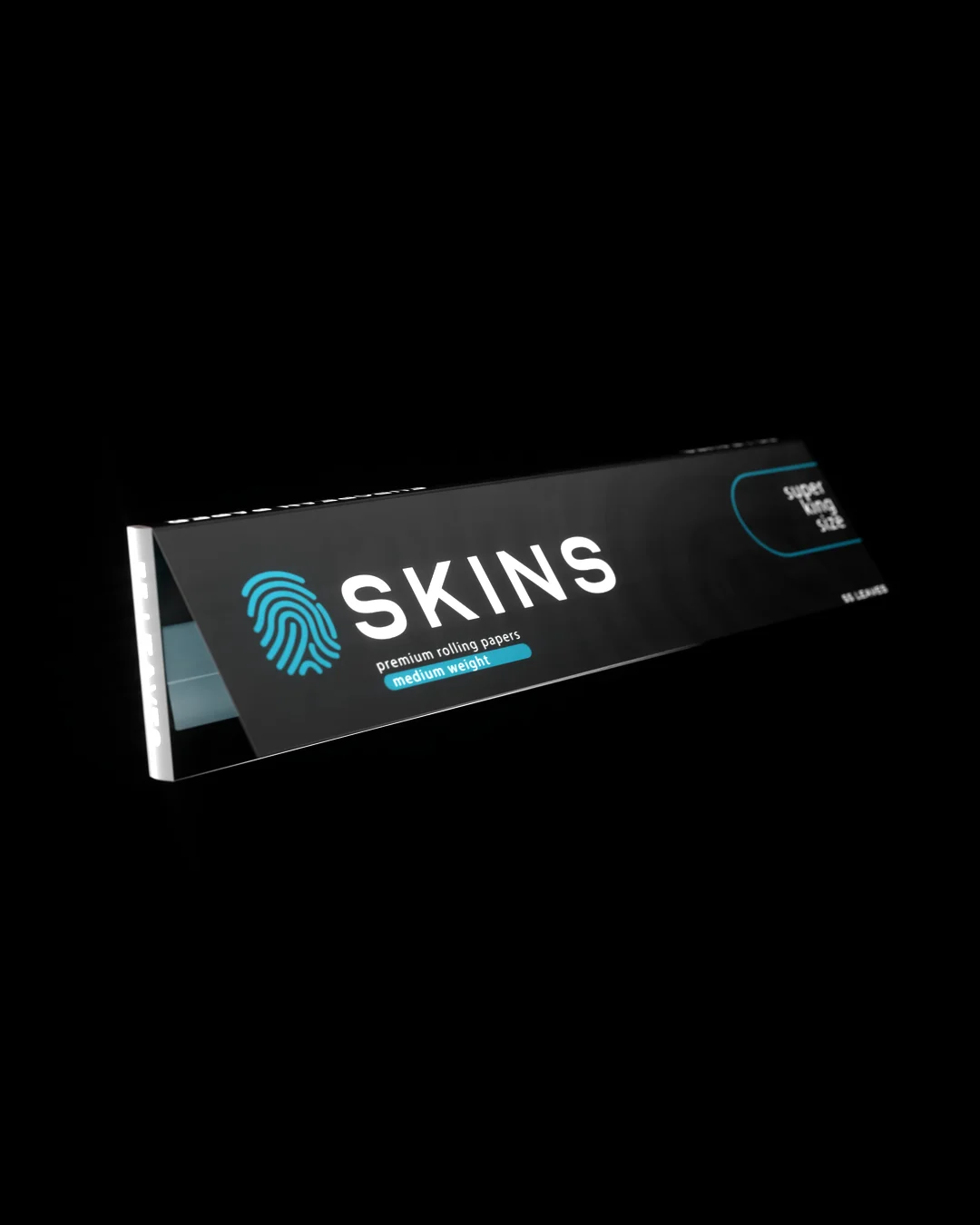
Two leaves sit side by side on the bench. One is the colour of oatmeal. The other is white enough to read the fingerprint through. Both are rolling papers, both are chlorine-free, and the difference between them is a single decision made at the pulp stage. This note explains that decision, what each bleaching route does to the fibre, and how much of the "unbleached is better" story survives contact with the burn test.
Why raw pulp is brown
Plant fibre is not one material. Cellulose, the long chain that gives paper its strength, is white. It is bound together in the plant by lignin, a dark, complex polymer that stiffens the cell wall, and by hemicelluloses that sit between the two. When fibre is pulped, most of the lignin is dissolved away, but some remains, and what remains is brown. The chemistry of lignin is the reason an unbleached leaf is the colour it is, and the reason that colour deepens slightly over years in the light.
Lignin is not inert. It is the fraction of the fibre that oxidises fastest and yellows first, and in a very thin sheet it contributes a small amount to the character of the ash. In practice, at rolling-paper weights, the fibre length and the basis weight matter far more, which is a point this note keeps returning to.
What bleaching actually does
Bleaching is the removal or decolouring of the residual lignin. There are three broad routes, and the industry taxonomy is worth knowing because the words end up on packs.
Elemental chlorine. Chlorine gas reacts with lignin and strips it out efficiently. It was the standard route for most of the twentieth century and it is the one the phrase "chlorine-free" exists to exclude. The objection is not the whiteness. It is that chlorine chemistry produces chlorinated organic residues, some of which stay in the sheet, and a rolling paper is a sheet that is about to be lit.
Elemental chlorine-free (ECF). Chlorine dioxide replaces chlorine gas. It is far cleaner in terms of residues, and it is how most white printing paper is made today. It is still chlorine chemistry, so it does not qualify as chlorine-free in the strict sense.
Totally chlorine-free (TCF). Oxygen, ozone and hydrogen peroxide do the work. No chlorine compound touches the pulp. The result is white, though not always as brilliantly white as an ECF sheet, and the residues are water and oxygen.
Unbleached. No bleaching step at all. The pulp is washed, refined and made into paper with its lignin tone intact.
| Route | Chemistry | Sheet colour | Chlorinated residues | Where it sits in the Skins range |
|---|---|---|---|---|
| Elemental chlorine | Chlorine gas | Bright white | Yes | Not used |
| ECF | Chlorine dioxide | White | Low, but present | Not used |
| TCF | Oxygen, ozone, peroxide | White to natural white | None | King Size, Super King Size, Pure Rice |
| Unbleached | None | Natural tone of the fibre | None | Unbleached, Organic |
The Skins paper page lists chlorine bleaching among the things that are not in the leaf. That means TCF or nothing. A white Skins paper is white because the pulp was bleached without chlorine, not because it was bleached with it, and an Unbleached or Organic Skins paper is the colour of its fibre because it was not bleached at all.
The cosmetic steps that follow
Bleaching sets the base tone. Two further steps are often applied on top of it, and both are worth separating from bleaching because they are frequently confused with it.
The first is optical brightening. Fluorescent compounds absorb ultraviolet light and re-emit it as blue, which makes a sheet look whiter than it is. Office paper is full of them. They do nothing for a rolling paper except make it glow under a bar's UV light, and they are not in a Skins leaf.
The second is dyeing. A sheet can be tinted to look natural, or coloured for effect. A brown paper is not automatically unbleached; some are bleached and then toned back. The only reliable read is the wording on the pack, and in the UK that wording is a product claim that has to be accurate under the Digital Markets, Competition and Consumers Act 2024. "Unbleached" means no bleaching step. "Chlorine-free" means no chlorine. They are not synonyms.
Unbleached is a description of what was not done to the fibre. It is not a description of how the leaf burns.
Does an unbleached leaf burn differently?
This is the question the category argues about, so it deserves a plain answer. In the Skins lab, an unbleached leaf and a TCF white leaf made from the same stock at the same basis weight go through the same six tests, and the burn readouts do not separate on colour. They separate on weight, on fibre length and on formation, which is why the note on how a rolling paper burns barely mentions bleaching.
What unbleached does change is smaller and more honest than the marketing suggests. There is one fewer process between the pulp and the leaf. The residual lignin gives the sheet a faintly warmer tone and a slightly softer hand, which some people prefer for the grip it offers when rolling thin. And on a blind flavour panel, which is test five in the Skins protocol, the pass mark is the same for both: no flavour transfer. A well-made unbleached paper and a well-made chlorine-free white paper both pass. A paper that fails usually fails on additives, not on colour.
Skins does not make health claims for any paper, and it does not claim that unbleached is better for anyone. It offers the choice because the fibre tone is a preference, and because the two lightweight papers that keep it, Unbleached and Organic, are made to the same specification as the white ones.
How to read a leaf
Three checks tell you most of what the pack will not. Hold the leaf to daylight: a natural, even cream tone with no blotching is unbleached long fibre; a flat, uniform brown that does not vary at all may be dyed. Hold it under a UV torch: a leaf that glows blue-white carries optical brighteners. Burn a scrap in still air: pale, minimal ash means fibre alone; a heavy, structured ash points to filler, whatever the colour of the sheet.
The rest is specification. Every paper in the Skins range, white or natural, is chlorine-free, free of brighteners and dyes, gummed with natural gum and verified batch by batch in the UK lab before it carries the fingerprint. Stockists receive that specification as a technical sheet through the trade page, and the note on what a rolling paper is made of sets out everything else the leaf leaves out.
Questions
Before you ask.
01Does unbleached rolling paper burn slower than white paper?
Not because of the colour. Burn speed is set by basis weight, fibre length, formation and the watermark. An unbleached leaf and a chlorine-free white leaf made on the same stock to the same weight burn the same way.
02What does chlorine-free mean on a rolling paper?
That no elemental chlorine or chlorine compound was used to whiten the pulp. The paper may still be white, bleached with oxygen, ozone or hydrogen peroxide, or it may be left unbleached. Skins is chlorine-free in every paper.
03Is brown rolling paper unbleached?
Usually, but not always. Brown is the natural tone of pulp that keeps its lignin. Some papers are dyed or toned to look natural. Read the pack: unbleached means no bleaching step at all, and a paper that says chlorine-free but is white was bleached without chlorine.
Sources
Where this comes from.
Sources checked on 28 Aug 2026. Legal notes are information, not advice; confirm with counsel before you act on them.
- 01Wikipedia: Bleaching of wood pulp (elemental chlorine, ECF and TCF sequences)
- 02Wikipedia: Lignin (the polymer that colours raw pulp)
- 03Wikipedia: Optical brightener (fluorescent whitening agents in paper)
- 04Digital Markets, Competition and Consumers Act 2024 (substantiating product claims in the UK)
Related notes
Read next.
Paper scienceAll markets
What is rolling paper made of? Fibre, gum and water
A rolling paper is plant fibre, a strip of natural gum and the water that carried them. What each does, and the six additives a good leaf leaves out.
7 min read
Paper scienceAll markets
Rice vs hemp vs wood-pulp rolling papers: fibre, feel and burn
Rice straw, hemp, flax and wood pulp each make a different leaf. How fibre length changes translucency, grip, burn and ash, with a side-by-side table.
6 min read
Paper scienceAll markets
Why a rolling paper burns unevenly, and what the watermark does about it
What happens at the burn front, why papers run, and how basis weight, formation and the cross-weave watermark keep the burn slow and even, no additives.
7 min read