
What makes a good rolling paper: the six tests behind a verified batch
What a batch is, why Skins verifies every one rather than holding a certificate, and the six tests in order with their pass marks.
- Publicado
- Tiempo de lectura
- 6 min de lectura
- Autor
- Skins
Nota en inglés
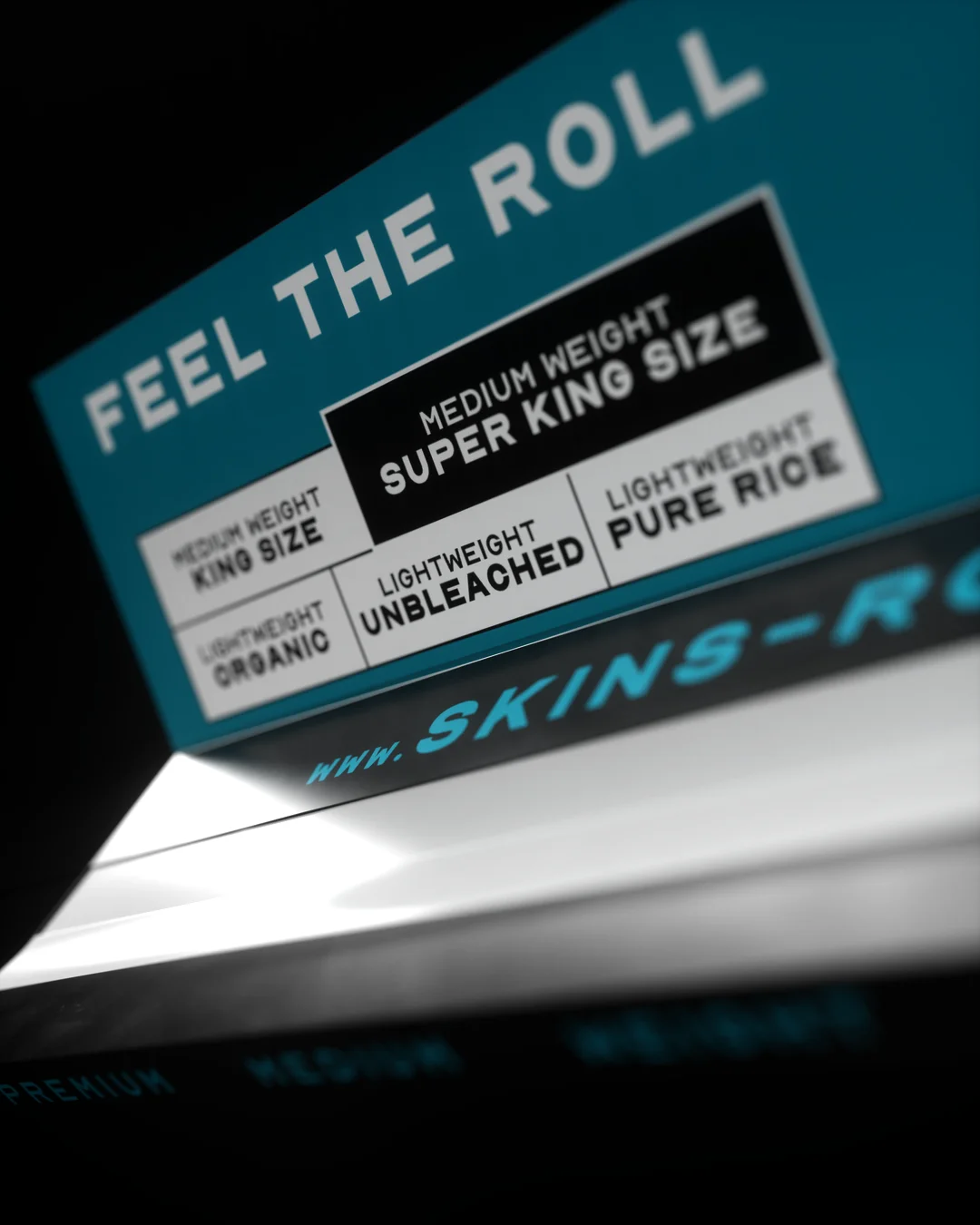
Every Skins booklet carries a fingerprint on the face. It is the brand mark, but it is also a statement: the batch this booklet came from was tested in the UK lab and passed. This note explains what a batch is, why batch verification is a different promise from a certificate, and what each of the six tests measures.
What a batch is
A batch is one production run of one paper. The mill makes a reel of stock; the converter gums, slits and folds it in one pass; the result is a set of booklets that share everything that can vary. Fibre, basis weight, formation, watermark, gum coat, interleaving. Within a batch these are fixed. Between batches they can drift, because pulp varies, machines are adjusted and gum is mixed fresh. The note on how the paper is made walks through each of those stages and where the variation enters.
That is why a one-off certificate says less than it appears to. A test result from a sample two years ago describes that sample. It does not describe the reel that ran last week. Skins verifies every batch, which means the fingerprint on a booklet refers to a test on the run that booklet came from, not to a document in a drawer.
Why the order matters
The six tests run in a fixed order, and the Research Centre explains why in one sentence: a leaf that fails the burn never reaches the roll, and a leaf that fails the roll never carries the fingerprint. The early tests are the physical ones that a mill can get wrong; the late tests are the ones that a person notices. There is no point asking a panel to taste a paper whose ash has already failed.
| Test | What is done | Pass mark |
|---|---|---|
| 01 Burn | A conditioned leaf is ignited in still air. The burn front is timed edge to edge and inspected for runs. | Slow, even, no runs |
| 02 Ash | Residue from the full burn is weighed and assessed for colour and structure. | Minimal, pale, no clumping |
| 03 Gum | The strip is activated at minimal moisture and peel-tested after ten seconds. | Holds first time |
| 04 Translucency | Transmitted light is read across the sheet to detect thick or thin zones. | Uniform across the sheet |
| 05 Flavour | Blind panel against the category reference papers. | No flavour transfer |
| 06 Roll | Hand-rolled twice by people who roll every day. | No splits, no drag |
01 Burn
A leaf is conditioned first, brought to a standard moisture so that the result reflects the paper and not the weather. It is lit at one edge in still air and the burn front is watched and timed as it crosses the sheet. Two things are being read: the speed, which should be slow, and the shape, which should stay a straight line. A run, where one part of the front races ahead, points to uneven formation, a missed watermark or an accelerant, all of which the note on how a rolling paper burns describes. The Skins leaf regulates its own burn through the cross-weave watermark, so a run is a fail, not a quirk.
02 Ash
What is left after the burn is weighed and looked at. A long-fibre leaf without filler leaves very little, and what it leaves is pale. Grey, structured ash means mineral filler, which adds body to a sheet and ash to the residue. Clumping means something has fused in the burn, usually a heavy gum coat or an additive. The pass mark is minimal, pale and loose, and it is one of the fastest ways to tell an honest ultra-thin paper from a heavier one made to look thin.
03 Gum
The strip is activated with the least moisture that will wet it, pressed onto the leaf, and peeled after ten seconds. It has to hold. This is a test of coat weight and strip width more than of the gum itself, since gum arabic is a known quantity; the note on natural gum explains what too little and too much each do. A strip that needs a second attempt, or more moisture than minimal, fails.
04 Translucency
The sheet is read in transmitted light across its full width. Thin zones read bright, thick zones dull, and a well-formed leaf reads the same edge to edge apart from the regular pattern of the watermark. This is the test that catches formation problems before they become burn problems, and it is the one the paper page turns into a scanning demonstration. Uniform is the pass mark.
05 Flavour
A blind panel compares the leaf against a set of reference papers from the category. The panel is not asked which is best; it is asked whether the leaf contributes any flavour of its own. Nothing in the paper should be tasted, so the pass mark is no transfer, and a paper with flavourings, brighteners or a heavy synthetic gum is where this test earns its place.
06 Roll
Last, the leaf is rolled by hand, twice, by people who roll every day. No instrument does this better. They are looking for splits, for drag at the tuck, for a seam that puckers and for a leaf that does not hold the shape it is given. Two clean rolls is the pass. A batch that reaches this test has already passed five; this one confirms that the specification holds in the hand.
The fingerprint is not a logo that was designed and then applied. It is the last thing that happens to a batch, and only if the other six did.
What stockists receive
The technical sheet carries the full Skins specification and the six pass marks. It goes to every stockist with the trade terms and a sample booklet, as the trade page sets out, and to distributors in the language of their market where available. It is written so that staff behind a counter can answer the questions customers actually ask: what is in the leaf, what is not, and how they can tell.
In the UK, the sheet is also what stands behind the claims on the pack. Product claims are subject to the unfair-practices rules of the Digital Markets, Competition and Consumers Act 2024, and marketing for rolling papers sits under CAP Code section 21. "Verified batch" is a claim Skins can substantiate, run by run, because the lab record exists for each one.
Grammage is measured to ISO 536, the same standard any paper mill uses, and the note on GSM and basis weight explains what it means. The rest of the protocol is Skins' own, built by people who spent years inside the trade before putting a name on a case. That story is on the story page. The protocol is what it turned into.
Preguntas
Antes de preguntar.
01What is a batch of rolling paper?
One production run of one paper: the same reel of stock, gummed and converted in one pass. A batch is the smallest unit at which everything that can vary, fibre, weight, watermark, gum and folding, is fixed.
02What happens if a Skins batch fails a test?
It does not carry the fingerprint. The order of the tests is deliberate: a batch that fails the burn is stopped there and never reaches the roll. Nothing is released on the strength of an earlier batch having passed.
03Can stockists see the test results?
Stockists receive the technical sheet, which carries the full specification and the six pass marks. It is the document staff use to answer questions at the counter, and it is sent with trade terms and a sample booklet.
Fuentes
De dónde procede esto.
Fuentes consultadas el 4 sept 2026. Las notas legales son información, no asesoramiento; confírmalo con un abogado antes de actuar.
Notas relacionadas
Leer a continuación.
Ciencia del papelTodos los mercados
Why a rolling paper burns unevenly, and what the watermark does about it
What happens at the burn front, why papers run, and how basis weight, formation and the cross-weave watermark keep the burn slow and even, no additives.
7 min de lectura
Ciencia del papelTodos los mercados
How ultra-thin rolling paper is made: from Alcoy to the calender
From long plant fibre to a 55-leaf booklet: pulping, the paper machine, the dandy roll that presses the watermark, calendering, gumming, then the lab.
6 min de lectura
ComercioTodos los mercados
How to become a rolling-paper stockist or distributor
The two trade routes into Skins, what arrives within two working days, what a distributor receives, age-of-sale and import basics, and a checklist.
6 min de lectura