
How to roll with ultra-thin rolling paper: technique for a light leaf
Handling technique for a near-transparent leaf: hand position, keeping the sheet dry until the seal, the tuck, why thin paper splits, and weight to skill.
- Publié
- Temps de lecture
- 6 min de lecture
- Auteur
- Skins
Note en anglais

An ultra-thin leaf behaves differently from an ordinary one, and most of the frustration people have with it comes from treating it the same way. This is a technique note. It covers the hands, the fold, the seal and the reasons a light leaf splits, and it says nothing about what goes inside, because the paper does not care. The same handling applies whether the roll is a practice run on the bench or the real thing.
Start with the leaf, not the hands
A rolling paper is mostly air and long fibre, and its behaviour tracks its moisture. Paper is hygroscopic: it takes up and gives off water until it matches the room, a property the materials literature calls equilibrium moisture content. A leaf that has spent a week in a dry, heated room is brittle and will crack at the fold. One that has lived in a humid pocket is limp, and its gum strip may already have half-activated against the next leaf.
So the first technique is not a technique. It is a closed booklet, kept somewhere neither hot nor damp, which the note on storing rolling papers covers. Take one leaf out, close the booklet, and work with dry hands. Moisture on the fingertips is transferred to the leaf on every touch, and the thinner the leaf, the faster that shows.
Orientation and the crease
Hold the leaf gum strip up and away from you, the strip along the far long edge. The interleaved fold in a Skins booklet already gives the leaf a light crease along its length; use it. A thin leaf does not need a hard second crease, and a sharp fingernail crease is the most common way to start a tear in a lightweight paper.
Rest the leaf across the first two fingers of each hand, pads up, so it forms a shallow trough. The thumbs will do the work; the fingers only support. On an ultra-thin sheet, the difference between supporting the leaf and pinching it is the difference between a clean roll and a split, because pinching concentrates all the stress on two points.
A light leaf is not fragile. It is unforgiving of uneven force. Spread the load and it will take a great deal.
Even fill, then shape
Whatever fills the leaf, distribute it evenly along the length before rolling, and slightly more at the ends than the middle. Uneven fill is the second most common cause of tearing: the paper is pulled tight over a high point while it stays slack elsewhere, and the tight point is where the fibre gives.
Shape by rolling the thumbs back and forth against the fingers, gently, until the contents form a cylinder and the leaf wraps it without strain. This stage is longer with a thin paper than a heavy one, because the thin paper does not hold a shape on its own; it takes the shape of what is inside it. The Pure Rice paper, the thinnest Skins makes, is almost entirely dependent on this step. Get the cylinder right and the rest is quick.
The tuck
The tuck is where thin paper is either mastered or torn. Bring the near edge, the one without gum, over the cylinder with the pads of both thumbs and slide it under, in one movement, rolling rather than pushing. The thumbs move away from you and slightly upward; the fingers roll the far side toward you to meet them.
Two rules. First, the pad of the thumb, never the nail. A nail edge on a lightweight leaf is a cutting tool. Second, do not stop halfway. A tuck that pauses lets the paper relax and bunch, and restarting it means pushing against a fold, which is where the split begins. If the tuck fails, unroll fully, re-shape, and start the movement again from the beginning.
The seal
With the near edge tucked, the gum strip is now the only thing left outside the cylinder. Moisten it lightly, and lightly means less than feels necessary. Natural gum arabic activates on minimal moisture and sets within seconds, which the note on natural gum explains in detail. Excess water dilutes the gum, softens the fibre beside the strip and is the main reason a seal lets go or the paper puckers at the seam.
Roll the last quarter turn so the strip lands on the paper below it, then run a thumb once along the seam with light, even pressure. Done properly, the seam on a Skins leaf disappears; the strip is narrow enough not to show. Test three in the Skins protocol checks exactly this, with the strip activated at minimal moisture and peel-tested after ten seconds. It has to hold first time, so if it does not, look at moisture and storage before blaming the paper.
Why it splits, and what to change
| Symptom | Most likely cause | What to change |
|---|---|---|
| Cracks along the crease before rolling | Leaf too dry | Store the booklet closed, away from heat; see the storage note |
| Tears at one point during the tuck | Uneven fill or nail edge | Level the fill; tuck with the thumb pad |
| Tears along the gum edge | Too much moisture on the strip | Use less; let the gum do the work |
| Seam opens after a minute | Strip under-activated or leaf humid | Slightly more moisture if the leaf is dry; dry the booklet out if it is limp |
| Leaf bunches and will not tuck | Tuck paused halfway | Unroll, re-shape, one continuous movement |
| Everything fine but slow | Wrong weight for your hands | Move to medium weight for speed, lightweight when ready |
Matching weight to skill
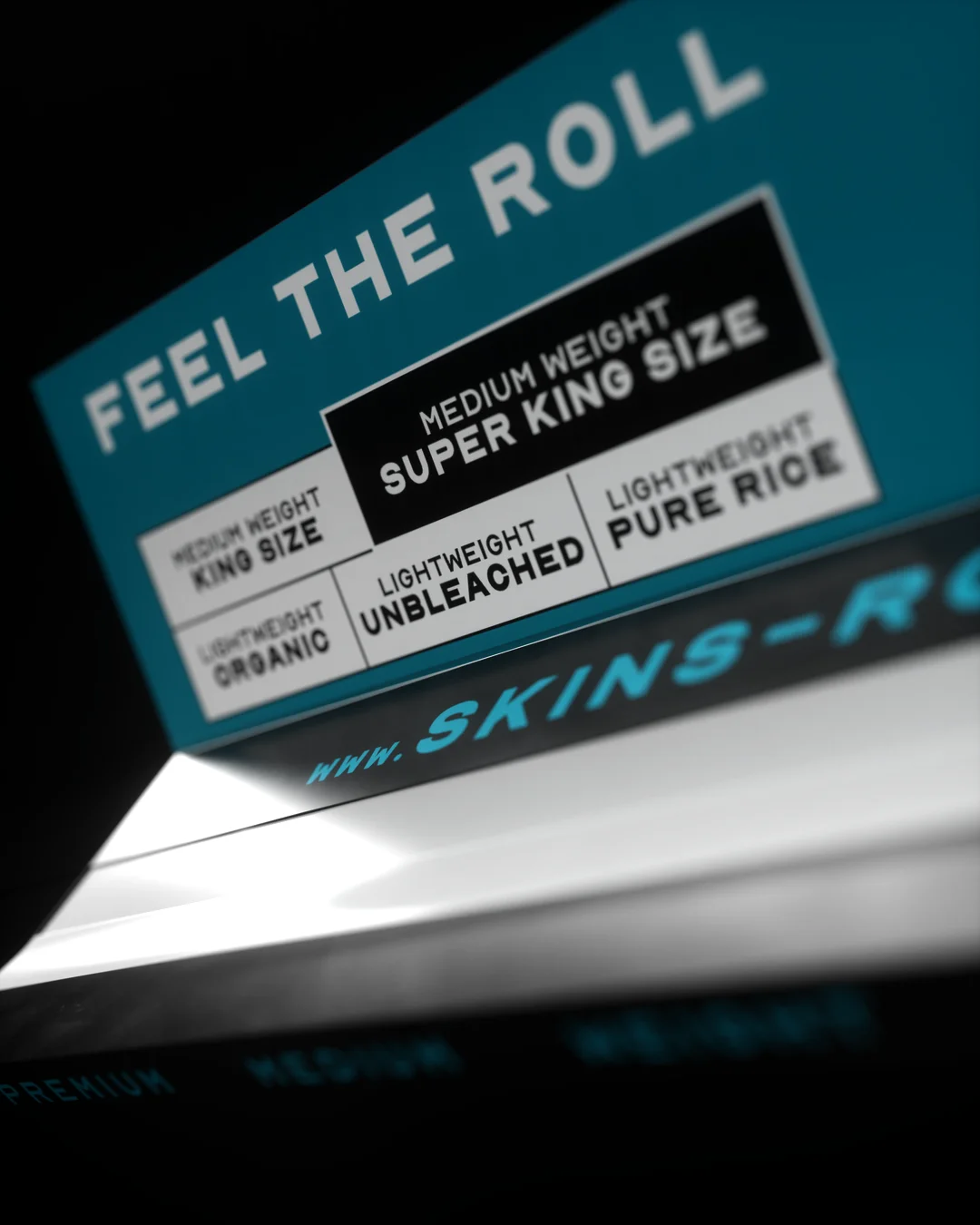
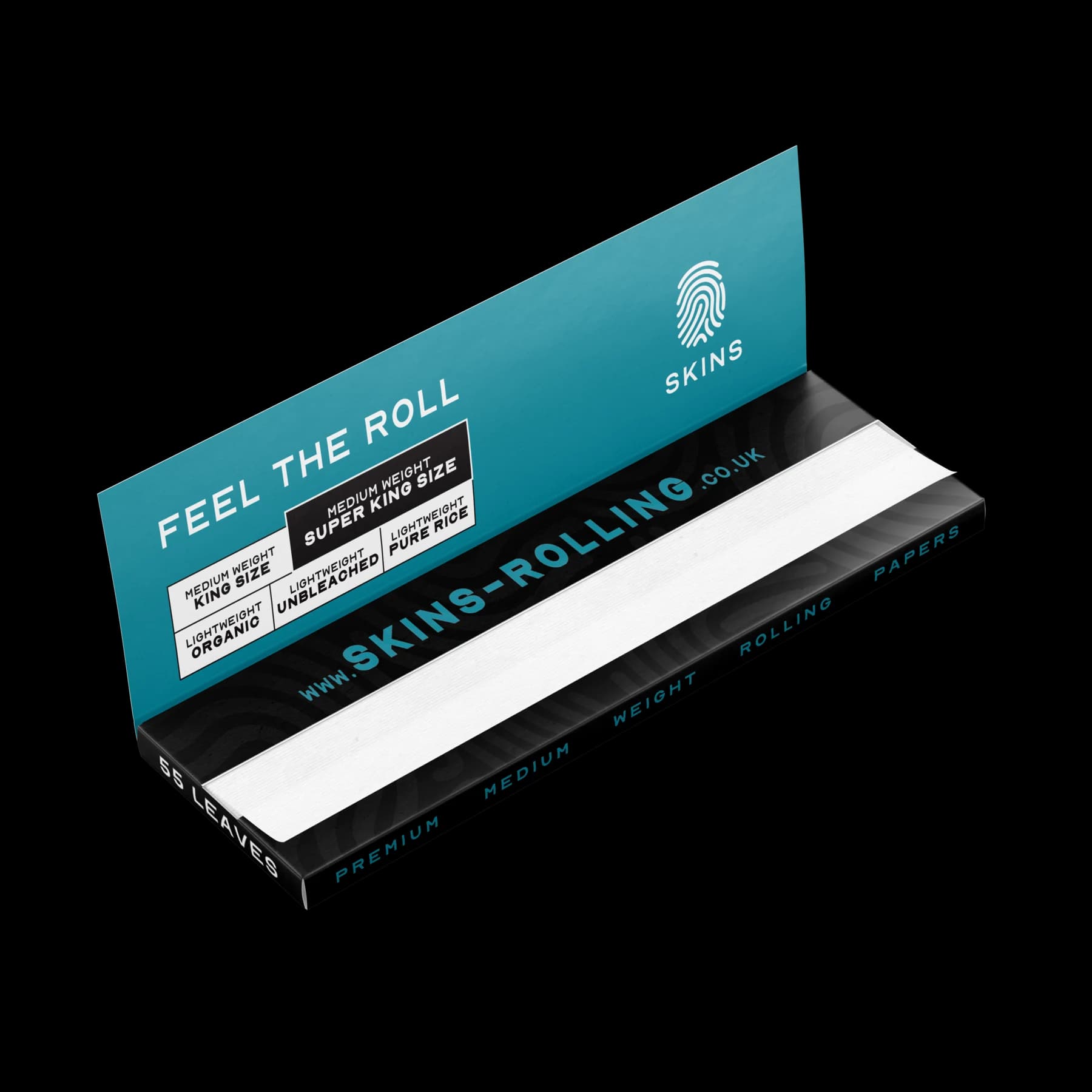
Skins makes two basis weights, and the difference is the point. The medium weight papers, King Size and Super King Size, have enough body to roll fast and hold their shape while the fill is being set, which is why the range page calls King Size the reference roll and why most counters stock it first. The lightweight papers, Organic, Unbleached and Pure Rice, are for people who want the least leaf possible and are prepared to roll with care.
The honest progression is medium weight until the tuck is automatic, then lightweight. The note on GSM and basis weight explains what those two weights mean physically, and the paper page explains why an ultra-thin leaf is worth the extra attention: it is there for structure until the moment it is lit, and then it is barely there at all.
None of this is difficult. It is a handful of habits, most of them about doing less: less moisture, less pressure, less nail, less hesitation. A light leaf rewards all four.
Questions
Avant de demander.
01Why does thin rolling paper tear when I roll?
Usually one of three things: the leaf is too dry and has gone brittle, the fill is uneven so the paper is being pulled at one point, or the tuck is being forced with a fingernail rather than rolled with the pad of the thumb. Fix the storage first, then the fill, then the hands.
02How much moisture does the gum strip need?
Very little. Natural gum activates on minimal moisture and sets in a second or two. More moisture dilutes the gum, softens the fibre beside the strip and is the usual reason a seal lets go.
03Which Skins paper is easiest to roll with?
King Size medium weight. It has enough body to roll quickly and hold its shape. The lightweight papers, Organic, Unbleached and Pure Rice, reward a steadier hand and are worth moving to once medium weight is second nature.
Sources
D’où cela vient.
Sources consultées le 1 sept. 2026. Les notes juridiques sont de l’information, pas un avis; confirmez auprès d’un conseiller juridique avant d’agir.
Notes connexes
À lire ensuite.
Science du papierTous les marchés
Rolling paper GSM: what basis weight does to burn, ash and translucency
GSM is grams per square metre. Why weight, not caliper, is the useful number, what it does to translucency, strength and ash, and the two Skins weights.
6 min de lecture

Science du papierTous les marchés
Natural gum on rolling papers, explained (and why the caramel line)
Gum arabic from acacia trees, how the strip is laid, why width and coat weight decide the seal, and why natural gum burns to a fine caramel line.
5 min de lecture
Technique et conservationTous les marchés
How to store rolling papers: humidity, heat and the gum strip
Paper tracks the humidity of the room. What too dry and too damp do to a leaf and its gum strip, a sensible range for a booklet, and a short checklist.
6 min de lecture