
King Size vs King Size Slim vs Super King Size: rolling paper dimensions
King Size, King Size Slim, Super King Size and the smaller formats in millimetres, what width does to the roll, and how to choose between them.
- Published
- Reading time
- 6 min read
- Author
- Skins
Note in English
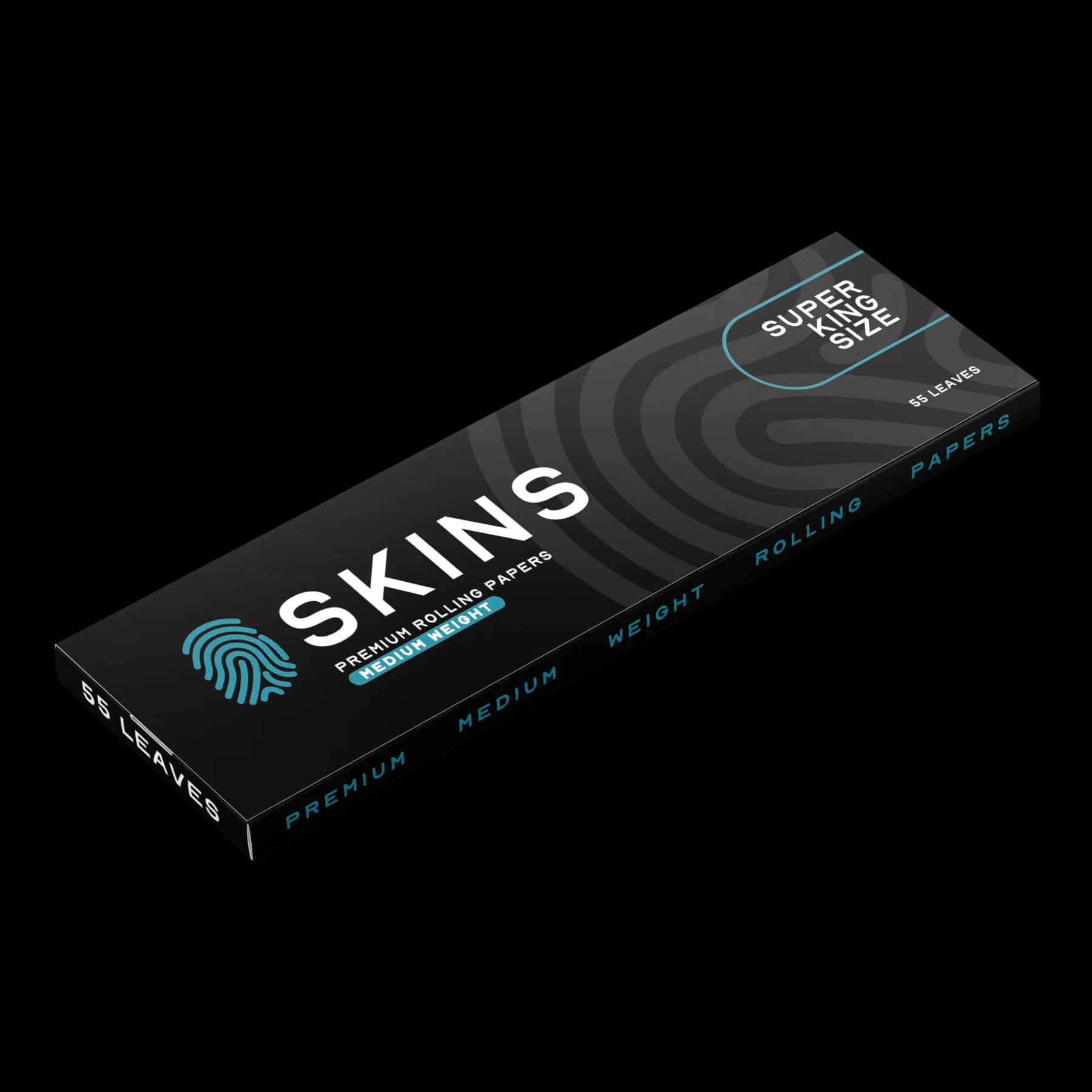
Rolling paper formats have names, not standards. King Size, 1¼, Slim and Super King are conventions that the category has settled on over a century, and each mill and each brand cuts to its own figures within them. That is why two packs on the same shelf, both marked King Size, can differ by a couple of millimetres in either direction. This note sets out the common formats in millimetres, explains what length and width actually change in the hand, and defines what Super King Size means for a Skins booklet.
The common formats
The table below gives the ranges you will find across the market. They are ranges rather than fixed numbers because there is no governing body for rolling paper dimensions; the figures are what the category has converged on, and any single brand's leaf will sit somewhere inside them.
| Format | Length | Width | Notes |
|---|---|---|---|
| Single wide (regular) | ~70 mm | ~36 to 38 mm | The original short leaf. Fast, small, little overlap. |
| 1¼ (one and a quarter) | ~76 to 78 mm | ~44 to 48 mm | The most common mid format, especially in North America. |
| 1½ (one and a half) | ~76 to 78 mm | ~60 to 62 mm | Same length as 1¼, noticeably wider. |
| King Size | ~100 to 110 mm | ~53 to 60 mm | The long standard format. Most European brands sit at 108 to 110 mm. |
| King Size Slim | ~105 to 110 mm | ~42 to 46 mm | King length, narrow width. |
| Super King Size | longer than King Size | brand-defined | An extended king; no industry figure. |
Two cautions. First, the sources that publish sizing charts, including the ones listed at the end of this note, disagree with each other by a millimetre or two on almost every row, because they measured different packs. Second, brands sometimes use the same name for slightly different cuts across their own ranges. Treat every number here as a working range and read the pack or the technical sheet for the exact leaf.
What length does
Length runs along the gum strip. A longer leaf gives more length to the finished roll and, at the same fill, a slower, longer burn front, because there is simply more paper and more contents to travel through. The burn note explains why the burn front's speed is set by the paper's weight and watermark rather than by its length; length only changes how long the front has to travel.
Length also changes handling. A 108 mm leaf needs both hands working along its full width, and an uneven fill shows more clearly on a long leaf than on a short one. The single wide format is quick precisely because there is little leaf to manage.
What width does
Width runs across the leaf, perpendicular to the strip, and it is the dimension that decides the diameter of the roll and the amount of overlap at the seal. This is the real difference between King Size and King Size Slim.
Slim is not a smaller paper. It is the same length with less width, which means less overlap and a thinner roll.
On a standard king width of around 55 mm there is enough paper to wrap the contents and leave a generous margin under the gum strip. That margin is forgiving: the tuck can be a little loose, the strip lands on plenty of paper, and the finished roll has a double layer over much of its circumference. On a slim width of around 43 mm the margin is smaller, the tuck has to be cleaner, and the roll ends up with a single layer over most of its surface. The result is a thinner, more elegant roll with less paper in the burn, which is why experienced rollers tend to prefer slim and why the technique note spends time on the tuck.
Width interacts with paper weight. A wide leaf on a heavy stock gives a lot of paper in the roll; a slim leaf on an ultra-thin stock gives very little. The GSM note covers the weight side of that equation. Skins pairs its king formats with two basis weights, medium weight and lightweight, so the amount of paper in the roll is set by weight as well as by cut.
What Super King Size means
Super King Size is the loosest term in the table. It has no industry definition beyond "longer than King Size" and brands use it for anything from a few millimetres of extra length to a substantially longer leaf. When you see it on a pack, the only safe reading is that the leaf is longer than that brand's own King Size.
For Skins, Super King Size is a defined product rather than a marketing word. The range carries two papers in medium weight: King Size and Super King Size. They are the same stock, the same natural gum strip at the same coat weight, and the same cross-weave watermark. Only the length changes. The burn profile is identical because the paper is identical; the extended leaf simply gives the burn front further to go. The Super King Size booklet is the one on the face of the case in the product renders, and it is the booklet most stockists start with when they want a single reference format.
The exact leaf dimensions for both are printed on the technical sheet that goes to stockists, alongside the specification described on the paper page. They are not reproduced here because a sizing note that quotes millimetres for its own products invites the same 2 mm arguments it has just warned about. The sheet is the authority.
How to choose a format
There is no correct size, only a correct size for a given roller and a given intent. A few working rules:
- Structure and speed: King Size in medium weight. Enough width for a forgiving tuck, enough body to roll quickly and hold shape. This is the reference roll and the one the Skins specification was written for.
- A thinner roll with less paper: King Size Slim, or a king width on a lightweight stock. Both reduce paper in the burn; slim does it through width, lightweight does it through basis weight.
- Length: Super King Size when the extended leaf is wanted. Same paper, same burn, more of it.
- Short and quick: single wide or 1¼. Skins does not make these formats; the range is built on king and super king.
Whatever the format, the things that decide how a paper behaves once lit are its weight, its fibre and its watermark, not its name on the pack. Those are covered in the note on how ultra-thin paper is made, and they are the things the Skins lab tests batch by batch.
Reading a pack
A quick method for comparing two packs when the numbers are not printed: lay a leaf from each on a flat surface, strip edge to strip edge, and align one corner. Length differences of 2 mm are visible immediately; width differences show at the far edge. If a brand's King Size and another brand's King Size Slim differ only at the far edge, you are looking at the width story in this note. If they differ along the strip, one of them is closer to a super king cut than its name suggests.
Sizes are a language the category shares imperfectly. The formats above are the vocabulary; the technical sheet is the dictionary for any specific paper.
Questions
Before you ask.
01What size is a king size rolling paper in mm?
Most king size papers are between 100 and 110 mm long and between 53 and 60 mm wide. King Size Slim keeps the length and narrows the width to roughly 42 to 46 mm. Each brand sets its own exact figures, so a 2 mm difference between two packs marked with the same name is normal.
02Is King Size Slim smaller than King Size?
It is the same length. Slim refers to the width only: the leaf is narrower, so there is less overlap at the seal and the finished roll is thinner. It is not a shorter paper.
03What is Super King Size?
An extended-length king format. There is no industry standard for the term; it means longer than that brand's King Size. The Skins Super King Size leaf is the same medium weight stock, gum strip and watermark as Skins King Size, cut longer, and the exact dimensions are on the technical sheet.
Sources
Where this comes from.
Sources checked on Aug 30, 2026. Legal notes are information, not advice; confirm with counsel before you act on them.
Related notes
Read next.
Paper scienceAll markets
Rolling paper GSM: what basis weight does to burn, ash and translucency
GSM is grams per square metre. Why weight, not caliper, is the useful number, what it does to translucency, strength and ash, and the two Skins weights.
6 min read
Technique and careAll markets
How to roll with ultra-thin rolling paper: technique for a light leaf
Handling technique for a near-transparent leaf: hand position, keeping the sheet dry until the seal, the tuck, why thin paper splits, and weight to skill.
6 min read
Paper scienceAll markets
How ultra-thin rolling paper is made: from Alcoy to the calender
From long plant fibre to a 55-leaf booklet: pulping, the paper machine, the dandy roll that presses the watermark, calendering, gumming, then the lab.
6 min read