
How ultra-thin rolling paper is made: from Alcoy to the calender
From long plant fibre to a 55-leaf booklet: pulping, the paper machine, the dandy roll that presses the watermark, calendering, gumming, then the lab.
- Published
- Reading time
- 6 min read
- Author
- Skins
Note in English
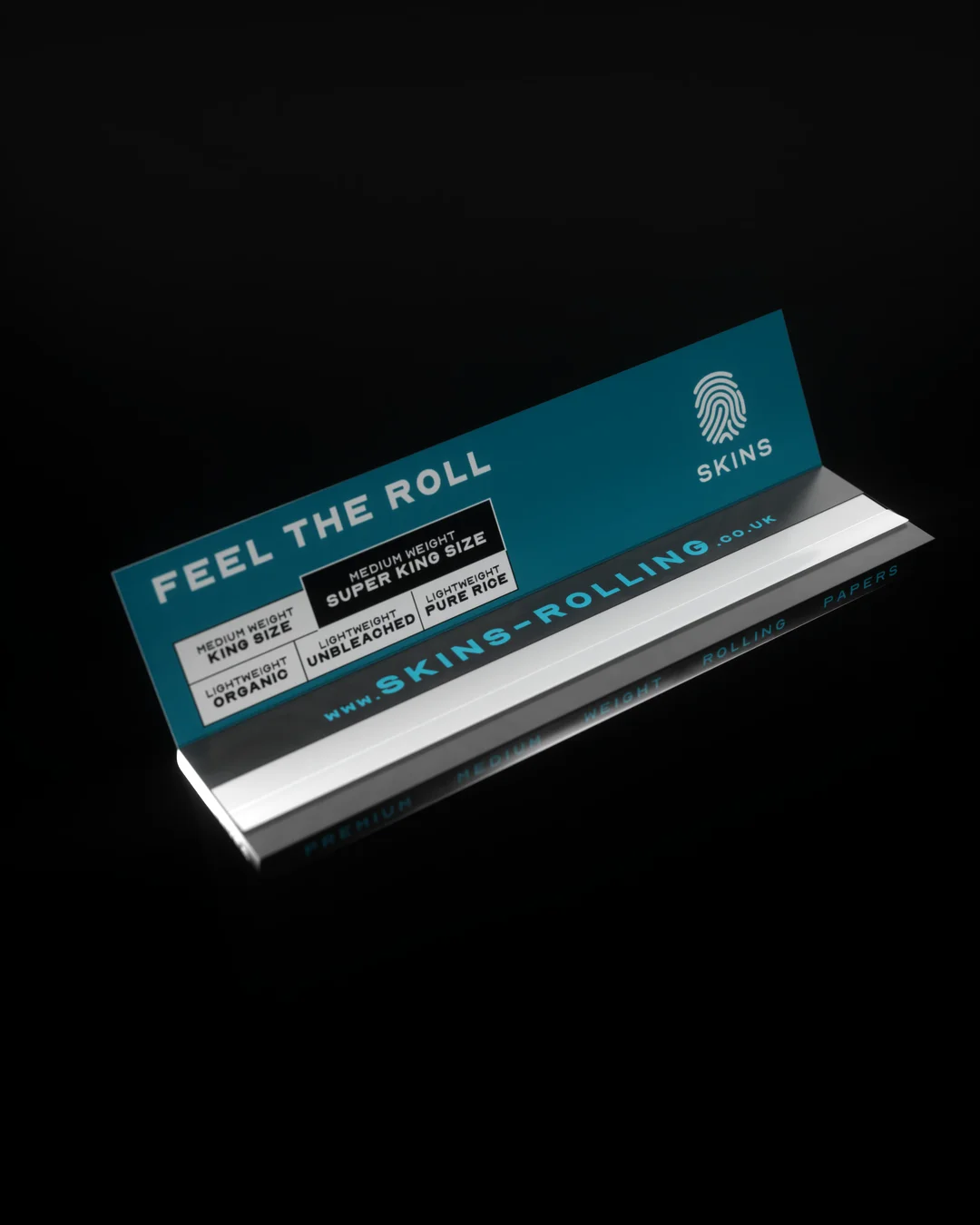
A rolling paper looks like the simplest thing in the pack. It is in fact the product of a machine several hundred metres long, a pattern pressed into wet fibre by a roller, and two centuries of refinement in one Spanish valley. This note follows a Skins leaf from pulp to booklet, and then to the bench in the UK lab where the batch is either passed or not.
Alcoy, where the category started
Cigarette paper as a product was first made in Alcoy, in the province of Alicante, in 1764. The town had water, fibre and the paper trade already, and it became the centre of an industry that later spread to France and beyond. The history of rolling paper is largely the history of that region: the mills, the converters that turn reels into booklets, and the workforce that knows what an ultra-thin sheet should feel like off the machine.
Skins does not own a mill and does not pretend to. It is manufactured in Spain, in the Alcoy region, by the mills and converters behind many of the most respected ultra-thin papers in the world, to a specification that is Skins' own. The Research Centre puts it in one line: the paper is theirs to make, the standard is ours to hold. The rest of this note is what "make" involves.
Pulp and refining
It starts with long plant fibre, the choice of which is covered in the note on rice, hemp and wood-pulp papers. The fibre is cooked and washed to remove most of the lignin that binds it in the plant, bleached without chlorine or left unbleached, and then refined.
Refining is mechanical. The fibres are passed between rotating discs that fray their surfaces and shorten them slightly, which sounds destructive but is what lets them bond. Frayed fibres interlock; smooth ones slide past each other. The degree of refining is one of the mill's most important controls, because it sets how strong the sheet will be at a given weight and how evenly it will form. For an ultra-thin paper, the target is a sheet that holds together at a basis weight where ordinary paper would fall apart, a point the note on GSM and basis weight makes in numbers.
The paper machine
The refined pulp is diluted to roughly one part fibre in ninety-nine parts water and fed onto the paper machine. On a Fourdrinier machine the slurry flows onto a moving mesh, the wire, where the water drains and the fibres settle into a mat. How evenly they settle is called formation, and it is the property that translucency reads directly: a well-formed sheet glows evenly against the light, a poorly formed one shows clouds.
While the sheet is still wet on the wire, a light roller covered in a patterned mesh, the dandy roll, rides on top of it. Where the pattern presses in, the sheet is thinned; where it does not, the sheet keeps its full weight. That pressed pattern is the watermark. On a banknote it is a portrait. On a rolling paper it is a fine regular grid, and on Skins it is a cross-weave. Its job is not decoration: it sets a repeating pattern of thin and thick zones that regulates airflow through the leaf and keeps the burn front slow and even, which the note on how a rolling paper burns explains in detail.
The watermark is pressed into the sheet while it is still mostly water. It is the mill's decision about how the leaf will burn, made before the leaf exists.
The wet sheet then passes through the press section, where felts and rollers squeeze out most of the remaining water, and the dryer section, a long train of steam-heated cylinders that takes it to a few percent moisture. It leaves the machine as a continuous reel, hundreds of metres long and less than a tenth of a millimetre thick.
Calendering
Off the dryers the sheet is dry but slightly rough. Calendering fixes that: the reel is run between stacked, heavy, often heated rollers under high pressure. The surface closes, the thickness evens out across the width, and the sheet takes on the smooth, faintly glossy hand that ultra-thin paper is known for. Calendering also increases translucency, because a denser, smoother sheet scatters less light.
There is a balance here. Calender too hard and the sheet becomes glassy and loses the grip that makes it rollable; too soft and it stays fluffy and opaque. The setting is part of the specification, and it is one of the reasons two papers of the same basis weight from different mills can feel completely different.
Gumming, slitting and the booklet
The calendered reel goes to a converter. First the gum: a narrow band of natural gum arabic is laid along what will become one long edge of each leaf and dried, at a width and coat weight Skins sets, as described in the note on natural gum. Then the reel is slit into leaf-width ribbons and cut to length.
The leaves are interleaved: each one folded so that pulling one out presents the next. Fifty-five of them are stacked, wrapped in the soft-touch board cover with the teal edge print and the fingerprint on the face, and cased in counter display boxes of twenty-five booklets. That is the unit of trade the stock page describes.
| Stage | Where | What it decides |
|---|---|---|
| Pulping and refining | Mill, Spain | Fibre length, strength at weight, colour |
| Forming on the wire | Mill, Spain | Formation, translucency |
| Dandy roll | Mill, Spain | The cross-weave watermark, burn regulation |
| Pressing and drying | Mill, Spain | Final moisture, dimensional stability |
| Calendering | Mill, Spain | Surface, hand, translucency, thickness tolerance |
| Gumming, slitting, interleaving | Converter, Spain | Strip width and coat weight, leaf format, booklet build |
| Six-test verification | Skins lab, UK | Whether the batch carries the fingerprint |
Then the lab
Nothing above is unique to Skins; it is how good rolling paper has been made for a long time. What Skins adds is the last row of the table. A sample from every batch is sent to the UK lab and put through the six tests in order: burn, ash, gum, translucency, flavour and roll. A batch that fails any of them does not carry the fingerprint. The note on what a verified batch means walks through each test and its pass mark.
That is the whole route. Fibre from the plant, formed on a wire in a valley that has been doing this since 1764, pressed with a watermark, calendered, gummed, folded into fifty-five and then checked. The Skins paper page describes the leaf it produces; this note is the reason it reads the way it does.
Questions
Before you ask.
01Where are the best rolling papers made?
The industry's historical centre is Alcoy in Alicante, Spain, where cigarette paper was first produced in 1764, and the mills and converters of that region still make many of the most respected ultra-thin papers. Skins is manufactured there to its own specification and verified in the UK.
02What is the watermark on rolling paper for?
It is a fine pattern pressed into the wet sheet by a dandy roll on the paper machine. It thins the sheet in a regular grid, which regulates how air passes through the leaf and keeps the burn front slow and even. On Skins it is a cross-weave pattern.
03What does calendered mean?
Passed between heavy, sometimes heated, rollers after drying. Calendering closes the surface, evens the thickness and gives an ultra-thin sheet its smooth hand and translucency.
Sources
Where this comes from.
Sources checked on Aug 31, 2026. Legal notes are information, not advice; confirm with counsel before you act on them.
- 01Wikipedia: Alcoy, Alicante (birthplace of cigarette paper, 1764)
- 02Wikipedia: Rolling paper (history and manufacture)
- 03Wikipedia: Paper machine (forming, pressing, drying and calendering)
- 04Wikipedia: Watermark (dandy roll and the pressed watermark)
- 05Wikipedia: Calender (the rollers that finish paper)
Related notes
Read next.
Paper scienceAll markets
What is rolling paper made of? Fibre, gum and water
A rolling paper is plant fibre, a strip of natural gum and the water that carried them. What each does, and the six additives a good leaf leaves out.
7 min read
Paper scienceAll markets
Rolling paper GSM: what basis weight does to burn, ash and translucency
GSM is grams per square metre. Why weight, not caliper, is the useful number, what it does to translucency, strength and ash, and the two Skins weights.
6 min read
VerificationAll markets
What makes a good rolling paper: the six tests behind a verified batch
What a batch is, why Skins verifies every one rather than holding a certificate, and the six tests in order with their pass marks.
6 min read