
What is rolling paper made of? Fibre, gum and water
A rolling paper is plant fibre, a strip of natural gum and the water that carried them. What each does, and the six additives a good leaf leaves out.
- Publié
- Mis à jour
- Temps de lecture
- 7 min de lecture
- Auteur
- Skins
Note en anglais
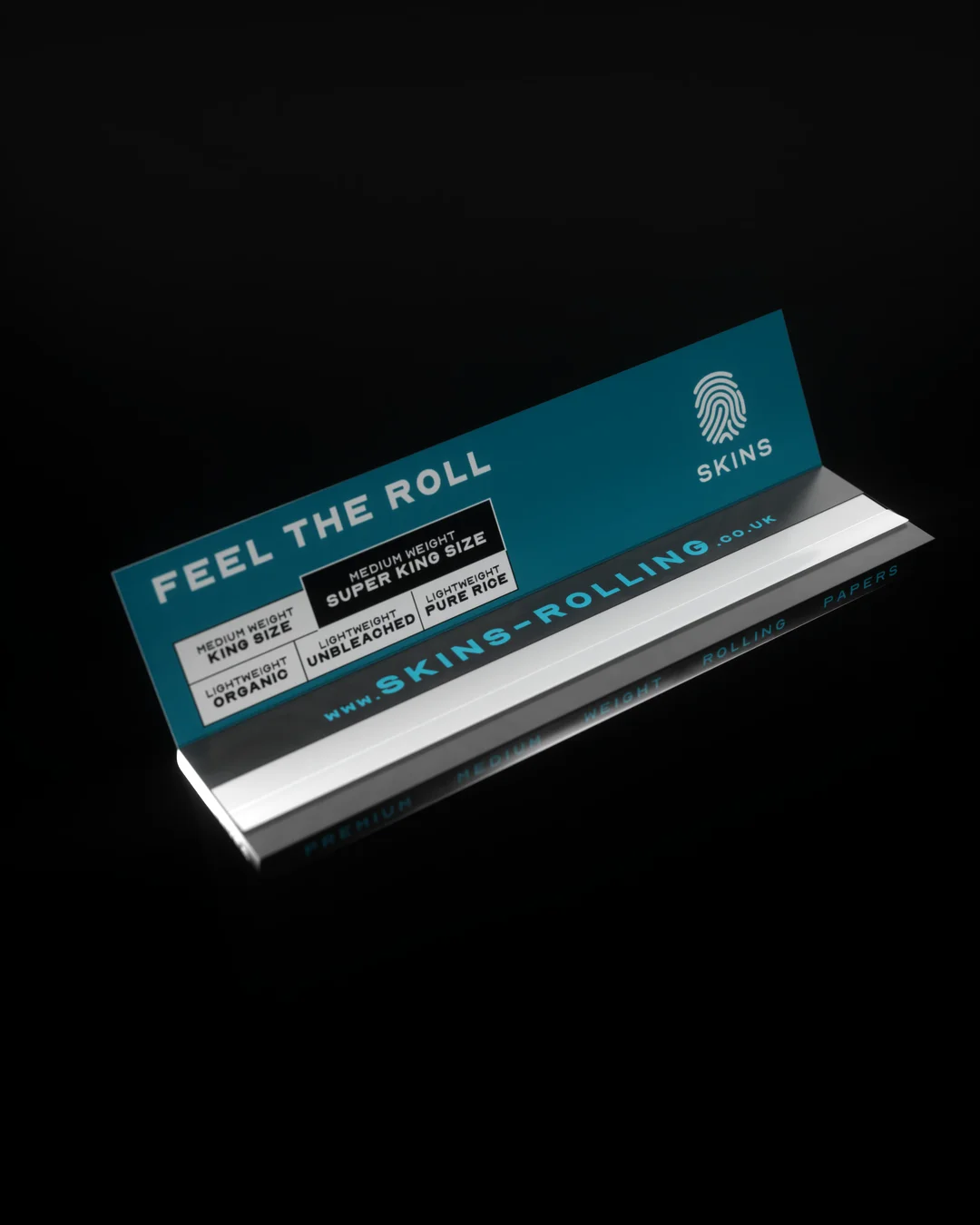
Ask most people what a rolling paper is made of and the answer is a shrug: paper. The more useful answer is that a rolling paper is a highly specific piece of paper engineering, built from three ingredients and defined as much by what is left out as by what goes in. This note walks through the three, in the order they matter, and then through the additives a serious paper does without.
Fibre: the leaf itself
Every rolling paper starts as a slurry of plant fibre in water. The fibre is the structural material. It is what lets a sheet be a fraction of the thickness of office paper and still roll, seal and burn without splitting.
Not every fibre will do. Ordinary printing paper is mostly short wood-pulp fibres bulked out with mineral fillers, which is why it tears easily when thin and leaves a heavy grey ash when burned. A rolling paper needs long fibres, refined so that they knit tightly and lie flat. The classic sources are flax, hemp, rice straw and sisal, alongside carefully prepared wood pulp. The industry grew up in Spain and France on flax and hemp rag; the modern range includes all of them, and each carries its own character in the hand, which is covered in the note on rice, hemp and wood-pulp papers.
Fibre length is the reason a paper can be ultra-thin. Long fibres overlap more, so a sheet holds together at a basis weight where short-fibre paper would fall apart. Long fibre also burns cleaner: there is less mass per square centimetre to leave behind, and no filler to turn into ash. The Skins paper page describes this as the leaf reading near-transparent against the light. That translucency is not a cosmetic choice; it is what a well-formed long-fibre sheet looks like at this weight.
Fibre decides the weight, the translucency and most of the ash. Everything else is finishing.
Two things happen to the fibre after it is pulped that decide the final leaf. The first is refining: the fibres are mechanically beaten so they fray and bond to one another, which is what gives a thin sheet its strength. The second is calendering, where the dried sheet is pressed between rollers to close the surface and even out the thickness. Both are described in the note on how ultra-thin paper is made.
Gum: the strip that seals
The second ingredient is the adhesive strip along one long edge. On papers described as natural gum, this is gum arabic, sometimes labelled acacia gum. It is the dried sap of acacia trees, harvested mainly in the Sahel, and it has been used as a food-grade water-activated adhesive for centuries. The pharmacology literature describes it as a complex polysaccharide with a small protein fraction, which is a technical way of saying it is a plant sugar that becomes tacky in water and dries clear.
What matters on a rolling paper is how the gum is applied. The strip is laid down at the mill as a thin aqueous coating in a band a few millimetres wide, then dried. Two variables govern its behaviour: the width of the strip and the coat weight, which is the amount of gum per unit area. Too little and the seal fails on the first attempt. Too much and the strip is stiff, needs more moisture to activate and burns to a bead rather than a line. Skins sets its own strip width and coat weight, which is why the seal holds first time and burns to the fine caramel line described in the natural gum note.
The alternative to natural gum in the category is a synthetic adhesive, usually a modified starch or a polymer. These are legal, widely used and perfectly functional. They are not in a Skins leaf because the specification is built on the principle that nothing should be in the paper that is not fibre, gum or water.
Water: the ingredient that leaves
Water is the third ingredient, and the one that is almost entirely gone by the time you hold the leaf. On the paper machine, the fibre is suspended in water at a ratio of roughly ninety-nine parts water to one part fibre. That slurry is spread onto a moving mesh, the water drains and is pressed and dried out, and the fibres are left behind as a sheet. Residual moisture in the finished leaf is a few percent by weight, and it matters: too dry and the paper is brittle, too damp and it will not roll cleanly. This is the reason the note on how to store rolling papers spends so long on humidity.
Water also carries the gum onto the strip and is what you add back, in a very small amount, to activate it. In that sense the recipe is honest about itself. The three things that go in are the three things you use.
What a good leaf leaves out
The category has a long history of additives, and most of them exist to make a paper look or behave like something it is not. The Skins specification excludes six of them, and the reasoning is worth setting out because it explains most of the differences between papers on a shelf.
| Additive | What it does | Why it is not in a Skins leaf |
|---|---|---|
| Chlorine bleaching | Whitens pulp by breaking down lignin | Leaves chlorinated residues in a sheet that is about to be lit. Oxygen and peroxide bleaching exist; Skins is chlorine-free throughout. |
| Optical brighteners | Fluorescent compounds that make paper look whiter under light | Cosmetic only. Adds nothing to the roll. |
| Dyes | Colour the sheet | A leaf should be the colour of its fibre, or as close to no colour as paper gets. |
| Pulp fillers | Minerals such as calcium carbonate that add body and opacity | Add ash and interrupt the burn. Skins holds weight through fibre, not filler. |
| Burn accelerants | Salts that keep a poorly formed sheet alight | A leaf that needs help to stay lit is the wrong leaf. The watermark regulates the burn instead. |
| Flavourings | Coat the sheet with sweet or aromatic compounds | Flavour transfer is a fail in the Skins protocol, not a feature. |
Two of these need a closer look. The first is bleaching, because the phrase "unbleached" on a pack is often read as "better" without much explanation. The unbleached versus bleached note sets out what each process actually does to the fibre. The second is burn accelerants, because they are the least visible and most consequential. A paper that has been treated to burn evenly regardless of how it was made will do exactly that, and it will also burn faster and hotter than a paper whose evenness comes from formation and a watermark. The difference is explained in the note on how a rolling paper burns.
Reading a paper by its ingredients
Once you know the three ingredients, a paper becomes legible. Hold it to the light: an even glow edge to edge means a well-formed long-fibre sheet; blotches mean uneven formation or filler. Look at the strip: a narrow, matte band that barely shows is a controlled coat of natural gum; a wide, glossy one is heavier and often synthetic. Burn a scrap in still air: pale, minimal ash is fibre alone; grey, structured ash is filler.
These three checks are, in a simplified form, three of the six tests in the Skins protocol. Every batch is burned, ash-weighed, gum-tested, read for translucency, tasted blind and rolled by hand before it carries the fingerprint. The specification that every paper in the range is built to lists exactly what is in the leaf and what is not, and stockists receive it as a technical sheet.
That is the whole recipe. Fibre for structure and burn, gum for the seal, water to carry both and then leave. A rolling paper that is made of anything else is answering a question nobody asked.
Questions
Avant de demander.
01Are rolling papers made from tobacco?
No. A rolling paper is plant fibre, a strip of gum and nothing else. It contains no tobacco and no nicotine, which is why most jurisdictions regulate it as an accessory or component rather than as a tobacco product.
02What is the gum on rolling papers made of?
On papers described as natural gum it is gum arabic, the dried sap of acacia trees. It is water-activated: a small amount of moisture makes it tacky, it bonds to the fibre, and it dries again in seconds.
03Why are some rolling papers brown and others white?
Colour comes from the fibre and from how it was treated. Unbleached paper keeps the natural tone of the pulp; white paper has had the lignin removed and the pulp bleached, historically with chlorine and now more often with oxygen or peroxide. Skins is chlorine-free in every paper.
Sources
D’où cela vient.
Sources consultées le 5 sept. 2026. Les notes juridiques sont de l’information, pas un avis; confirmez auprès d’un conseiller juridique avant d’agir.
Notes connexes
À lire ensuite.
Science du papierTous les marchés
Natural gum on rolling papers, explained (and why the caramel line)
Gum arabic from acacia trees, how the strip is laid, why width and coat weight decide the seal, and why natural gum burns to a fine caramel line.
5 min de lecture
Science du papierTous les marchés
Rice vs hemp vs wood-pulp rolling papers: fibre, feel and burn
Rice straw, hemp, flax and wood pulp each make a different leaf. How fibre length changes translucency, grip, burn and ash, with a side-by-side table.
6 min de lecture
Science du papierTous les marchés
How ultra-thin rolling paper is made: from Alcoy to the calender
From long plant fibre to a 55-leaf booklet: pulping, the paper machine, the dandy roll that presses the watermark, calendering, gumming, then the lab.
6 min de lecture