
How to store rolling papers: humidity, heat and the gum strip
Paper tracks the humidity of the room. What too dry and too damp do to a leaf and its gum strip, a sensible range for a booklet, and a short checklist.
- Published
- Reading time
- 6 min read
- Author
- Skins
Note in English
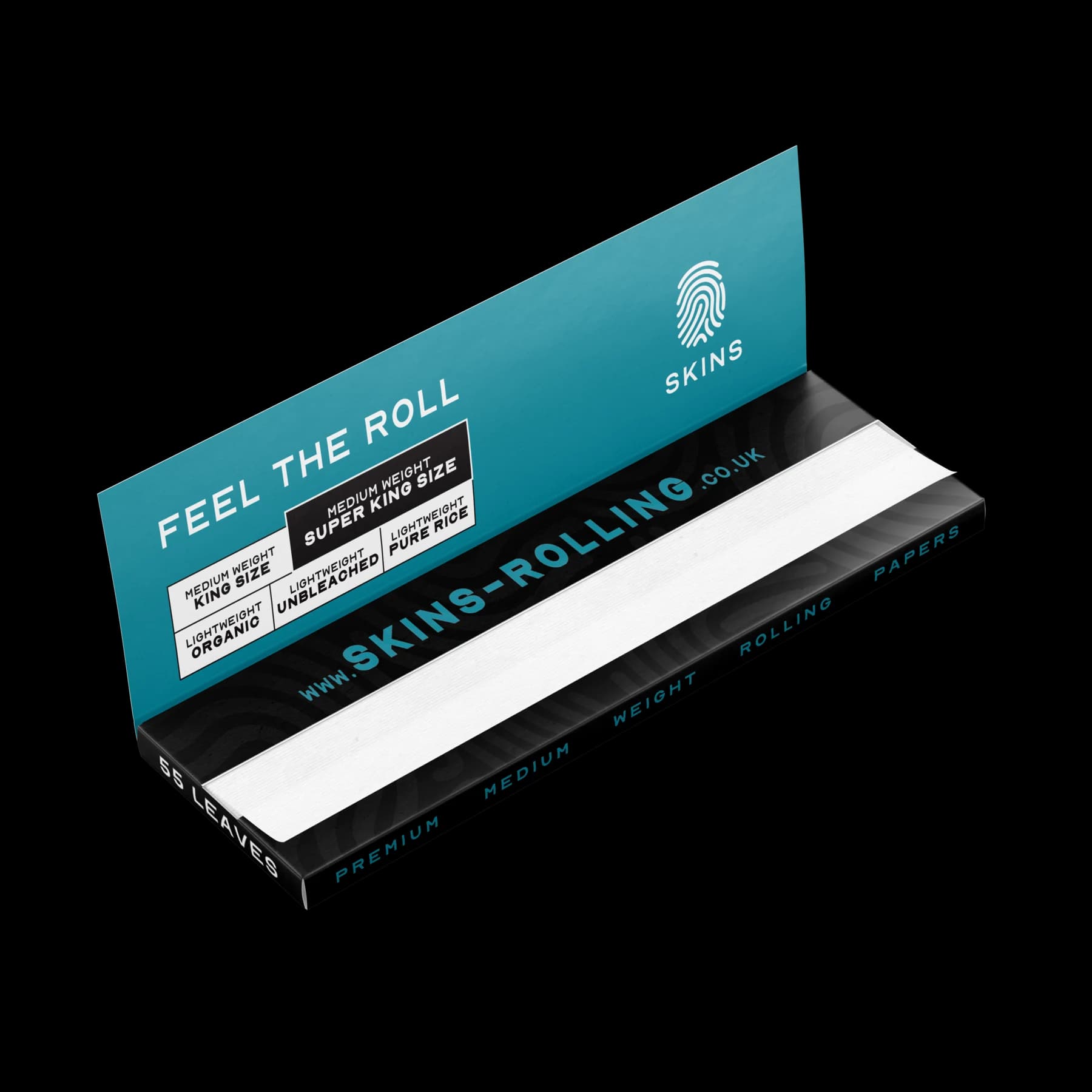
A booklet of rolling papers is a small stack of a very hygroscopic material with a water-activated adhesive along one edge of every leaf. Storage is therefore almost entirely about moisture. This note explains what the room does to the leaf, what the symptoms are at each end of the range, and how to keep a booklet in the condition it left the lab.
Paper follows the room
Cellulose fibre absorbs and releases water vapour until its moisture content is in balance with the air around it. The materials literature calls the balance point equilibrium moisture content, and for paper it rises with relative humidity: in a dry room a leaf settles at a few percent water by weight, in a humid one at roughly double that. Temperature matters less directly, but warm air holds more water and warm places, a car dashboard, a pocket against the body, drive the swing in both directions.
The change is not cosmetic. Moisture is what makes a thin sheet flexible. Below the range the fibres stiffen and the leaf cracks at the fold; above it they soften and the leaf loses the body it needs to roll. The paper page describes the Skins leaf as reading near-transparent and rolling without splitting, and both of those statements assume a leaf at sensible moisture.
Too dry
A booklet left near a radiator, in a heated car or in a centrally heated flat over winter dries out over days. The first sign is static: leaves that cling to the fingers or to each other. Then the crease sharpens and the leaf cracks along it when opened. At the tuck, an ultra-thin leaf that is too dry splits rather than bends, which is the failure the note on rolling with ultra-thin paper spends most of its time preventing.
The gum strip on a dry leaf is fine; gum arabic is stable when dry and is simply waiting for water. The temptation is to add more moisture at the seal to compensate for the brittle feel. Do not. The fix is to let the closed booklet sit in a normal room for a day or two and take moisture back from the air.
Too damp
The other direction is more common and does more damage. A booklet in a bag in summer, in a bathroom, or in a pocket against the body picks up moisture steadily. The leaves go limp and lose the faint crispness that makes them easy to separate. More seriously, the gum arabic strip begins to activate. It becomes tacky against the leaf below it, then dries again when the booklet moves somewhere drier, and the result is a strip that has already spent its adhesive and no longer seals, or leaves that tear when separated because they are glued along the edge.
A damp booklet can usually be dried out in a normal room, closed, over a day or two. What cannot be undone is a strip that has pre-activated and set; those leaves will need more moisture than they should to seal, and the seam will be weaker. This is the most common reason for the complaint that a gum strip does not stick, and it is a storage problem, not a paper one, as the note on natural gum sets out.
The gum strip is water-activated by design. Anything that brings water to it before you do has already started the seal without you.
Heat and light
Two slower effects are worth knowing. Direct sunlight photo-oxidises the residual lignin in fibre and yellows it; a white leaf left on a windowsill for a summer will tone toward cream. It burns the same, but the point of the chlorine-free white papers in the range is that they arrive without that tone. Sustained heat, above what a warm room reaches, dries the leaf and can make the gum brittle enough to flake. Neither is a concern for a booklet kept in a drawer.
A sensible range
There is no need to measure anything. A normal living room, out of direct sun and away from heaters, is inside the range a rolling paper wants. As guidance, roughly 40 to 55 percent relative humidity at room temperature keeps the leaf flexible without waking the gum, and most homes sit there most of the year. The places that do not are the ones already named: bathrooms, cars, radiators, and any pocket that spends the day against the body.
| Symptom | Likely cause | Fix |
|---|---|---|
| Leaves cling, static on the fingers | Too dry | Closed booklet in a normal room for a day or two |
| Cracks along the crease | Too dry, sometimes heat | As above; avoid heaters and cars |
| Leaves limp, hard to separate | Too damp | Closed booklet somewhere drier; never add heat |
| Gum strip tacky before use | Damp, pre-activating | Dry out; expect the affected leaves to seal weakly |
| Gum strip will not seal at all | Pre-activated and set, or too much moisture at the seal | Use less moisture on fresh leaves; discard leaves that have glued together |
| Leaf has yellowed | Sunlight | Store in the dark; harmless to the burn |
Why the booklet is built the way it is
The Skins booklet is designed as its own storage. Fifty-five leaves are interleaved so that each one is folded around the next and only the top leaf is exposed; the rest sit protected, with their gum strips inside the fold and away from the air. The soft-touch board cover closes over them. Kept shut, the booklet slows the exchange of moisture with the room considerably, and the interleaving is why a booklet opened and closed a hundred times still presents a clean leaf at the end. The note on how the paper is made covers the interleaving at the converter.
The counter display box of twenty-five booklets that the trade page describes does the same job at the shop: closed booklets, out of direct light, at room conditions. A retailer who keeps the box away from the window and the door will hand over booklets in the state the lab passed them.
The checklist
- Keep the booklet closed between leaves.
- Room temperature, out of direct sun, away from radiators and vents.
- Not in a car, a bathroom, or a pocket that spends the day against the body.
- If it is brittle, rest it closed in a normal room; do not add water.
- If it is limp or tacky, rest it closed somewhere drier; do not add heat.
- Use minimal moisture at the seal, always.
Fibre, gum and water are the whole recipe, as the note on what a rolling paper is made of explains. Storage is just keeping the third one at the right level until it is needed.
Questions
Before you ask.
01Do rolling papers go off?
Not in the sense of expiring. Fibre and gum arabic are stable for years if kept dry, closed and out of sunlight. What changes with poor storage is moisture: a dried-out leaf goes brittle and a damp one goes limp with a gum strip that has lost its tack.
02Can dried-out rolling papers be revived?
Often, yes. Leave the closed booklet in a normal room, away from heat, for a day or two and the leaves will take moisture back from the air. Do not add water directly; that activates the gum and sticks the leaves together.
03Why is my gum strip not sticking?
Either the booklet has been humid and the gum has pre-activated against the next leaf and dried again, or too much moisture is being used on the strip at the seal. Dry the booklet out in a normal room and use less moisture.
Sources
Where this comes from.
Sources checked on Sep 2, 2026. Legal notes are information, not advice; confirm with counsel before you act on them.
Related notes
Read next.

Technique and careAll markets
How to roll with ultra-thin rolling paper: technique for a light leaf
Handling technique for a near-transparent leaf: hand position, keeping the sheet dry until the seal, the tuck, why thin paper splits, and weight to skill.
6 min read

Paper scienceAll markets
Natural gum on rolling papers, explained (and why the caramel line)
Gum arabic from acacia trees, how the strip is laid, why width and coat weight decide the seal, and why natural gum burns to a fine caramel line.
5 min read
Paper scienceAll markets
What is rolling paper made of? Fibre, gum and water
A rolling paper is plant fibre, a strip of natural gum and the water that carried them. What each does, and the six additives a good leaf leaves out.
7 min read